

Ultrasound-Guided Injections: What They Are and When They Help
Injections have a reputation problem. Some people expect them to fix the problem outright, and some avoid them entirely on the assumption they are a short-term patch that stores up trouble. Neither is quite right.
Used well, an injection is a tool for changing the conditions around a problem so that the things which genuinely resolve it — loading, strengthening, graded return to activity — become possible. Used without that context, it is a temporary quietening of a symptom.
What the ultrasound part actually changes
A landmark-guided injection is placed using surface anatomy: the clinician identifies the target by feel and by knowledge of where the structure should be. That works reasonably well for large, superficial joints and less well for everything else.
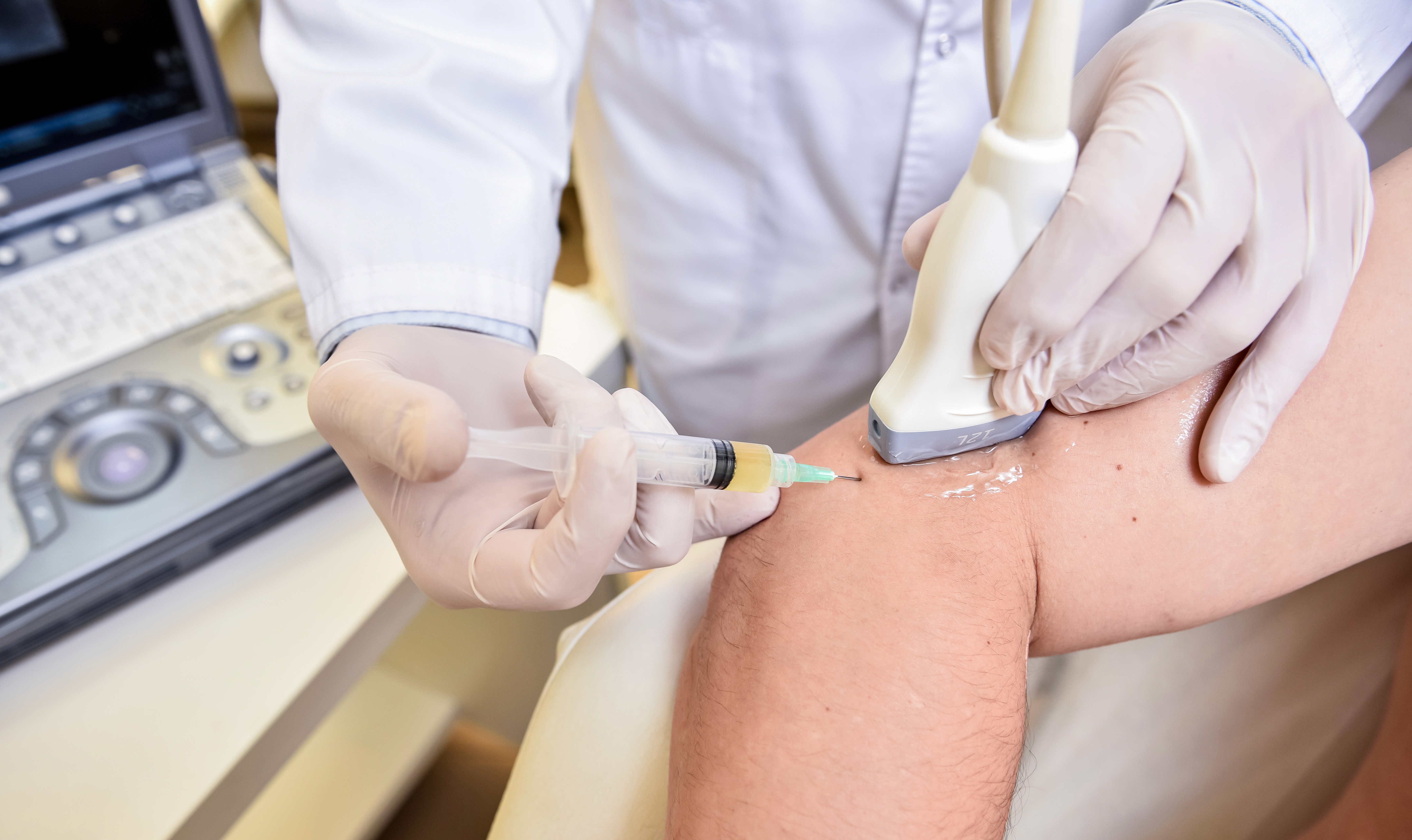
Ultrasound guidance means the needle is visualised in real time as it moves, alongside the structure being targeted. The clinician can see the tendon, the joint space, the bursa or the nerve, and can confirm the injectate has gone where it was intended rather than into surrounding tissue.
The practical consequences are better accuracy, particularly for small or deep structures, and often less discomfort, because there is less need to reposition the needle. It also means the surrounding anatomy is being assessed at the same time, which occasionally changes the plan before anything is injected at all.
The main types
Corticosteroid reduces inflammation and can produce meaningful short-term relief. It is most useful when pain is limiting someone's ability to do the rehabilitation that will actually improve things. Repeated injections into or around tendons are approached more cautiously, as the longer-term effects on tendon tissue are less favourable.
Hyaluronic acid is used primarily in osteoarthritic joints, with the aim of improving joint lubrication and comfort over a longer period than a corticosteroid typically provides.
Platelet-rich plasma (PRP) uses a concentrated preparation from a sample of your own blood. Interest in it is high, and the evidence is genuinely mixed — it appears more promising for some conditions than others, and it is not a universal answer. It is discussed on a case-by-case basis rather than offered by default.
Botulinum toxin is used in selected cases where muscle overactivity is contributing to the problem.
Not every condition needs an injection, and suitability is decided in consultation rather than in advance.
What it involves
The procedure itself is usually quick. The area is cleaned, local anaesthetic is used where appropriate, and the injection is placed under direct ultrasound visualisation. Most people are able to walk out and go about their day, with specific guidance given afterwards on activity, loading and what to expect over the following days.
At Blackrock Clinic, injections are carried out either in the Minor Procedure Department or, where appropriate, in the Suite 16 consultation suite.
The part that matters most
An injection rarely changes the underlying reason a structure became painful. If a tendon became irritable because load increased faster than it could adapt, reducing the pain does not change the tendon's capacity — and returning straight to the previous training load tends to reproduce the problem.
The most useful way to think about it is as a window. It creates a period in which rehabilitation is more tolerable and progress is more achievable. What happens inside that window determines whether the result holds.
Insurance and cover
Most patients use private health insurance for consultations and investigations, though cover for procedures varies between insurers and policies. Common procedure codes are 4334 for a large joint injection, 4333 for a small joint injection, 4331 for a tendon or soft tissue injection, and 9830 for ultrasound guidance. It is worth confirming your level of cover with your insurer directly before treatment. Self-pay options are available.
This information is educational and does not replace an individual medical assessment.